



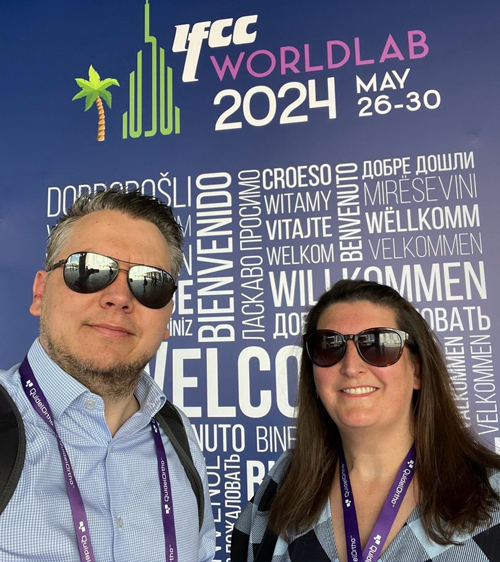
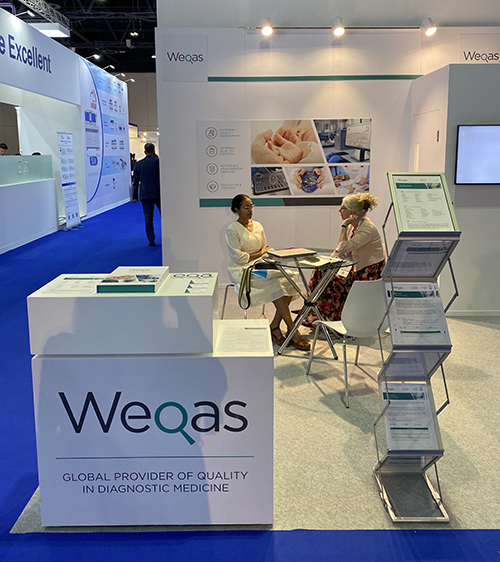
The Weqas team had a great time in Dubai this week exhibiting at the IFCC #WorldLab congress. The posters that were presented at the event are available to download below: They include, Performance of Lacate on Blood Gas analysers for Sepsis Management, POCT CRP performance as a tool to support antibiotic prescribing, and the Performance on Quantitative Faecal Haemoglobin (FIT) at the critical threshold.
Next year, EuroMedLab heads to Brussels; we hope to see you there.
Lactate was introduced as part of the Weqas Blood Gas EQA programme in 2001, with 33 laboratory enzymatic methods and 295 blood gas analysers in use at the end of the first 5 years compared with 43 enzymatic and 2116 blood gas or lactate meters used in 2023.
Programme: Blood Gas
POCT CRP has increasingly been used in primary care to support prescribing in suspected acute respiratory infection and in 2017, Weqas developed an EQA programme to assess and monitor the performance of these devices in primary care.
Programme: POCT CRP

A Review of Performance on the Weqas Quantitative Faecal Haemoglobin (FIT) EQA Programme – Are current analysers ‘FIT’ for purpose?
1 file(s) 429.47 KB May 15, 2024
In the UK, these tests are recommended by National Institute for Health and Care Excellence (NICE) to guide referrals for suspected colorectal cancer in symptomatic patients using a threshold of 10 µg Hb/g of faeces (guidance DG56 (formally DG30) and NG12). NICE guidance DG56 states ‘Refer adults using a suspected cancer pathway referral (as outlined in NICE’s guideline on suspected cancer) for colorectal cancer if they have a FIT result of at least 10 micrograms of haemoglobin per gram of faeces.’
In 2016, Weqas developed an EQA programme to assess and monitor the performance of these tests. 62 instruments were initially registered at the onset of the programme with participants within the UK and overseas. In 2024, there are 101 instruments registered.
Programme: Quantitative Faecal Haemoglobin
Last updated: 30/05/2024