

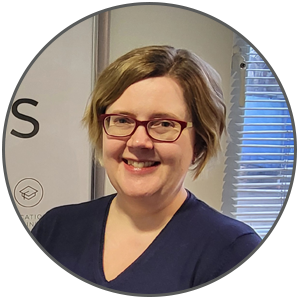
Ceri Parfitt
R&D Clinical Scientist
What if your love of science could help improve patient care across the world?
That is exactly what Ceri does as a Clinical Scientist at Weqas. From supporting laboratories to improve the quality of diagnostic testing to developing innovative External Quality Assessment (EQA) programmes, her work helps ensure healthcare professionals can trust the results that inform patient care every day.
Yet Ceri’s career didn’t begin in a hospital laboratory. It started with a curiosity about science, a chemistry degree and a desire to see how scientific knowledge could make a difference in the real world.
How Ceri Became a Clinical Scientist Through the NHS Scientist Training Programme (STP)
Ceri’s route into pathology began with a degree in Chemistry before spending time in academia. She enjoyed the science but wanted to see more directly how her work could influence healthcare and patient outcomes. The NHS Scientist Training Programme (STP) bridged the gap between academic knowledge and clinical practice, taking her to a training placement in Exeter. After qualifying as a Clinical Scientist, she worked in Stoke before joining the Weqas team.
For students considering a career in healthcare science, the NHS Scientist Training Programme (STP) is the first step towards becoming a Clinical Scientist. Trainees are employed by the NHS while studying, meaning they gain hands-on experience in real healthcare environments from day one.
During the programme, trainees might find themselves investigating unusual laboratory results, supporting diagnostic services, working alongside clinicians and healthcare scientists, or undertaking research projects that could improve patient care. Every day brings new challenges and opportunities to apply science in a meaningful way.
For Ceri, this combination of structured learning and real-world responsibility helped turn a passion for science into a career with visible patient impact. Today, she applies that foundation to research, External Quality Assessment and the development of innovative approaches that help laboratories recognise risk and improve practice.
No two days are exactly the same. One day Ceri may be reviewing data from an External Quality Assessment programme, while the next she may be working on research, collaborating with laboratory professionals, analysing performance trends or developing new approaches to improve testing quality. She also participates in the Duty Biochemist rota at the University Hospital of Wales, interpreting patient results and providing clinical advice to support patient diagnosis and management.
“One of the things I enjoy most is the variety. You’re constantly learning, solving problems and working with people who are passionate about improving healthcare.”

Developing the Weqas Total Testing Pathway EQA Programme
One of Ceri’s most significant projects is the development of the Weqas Total Testing Pathway (TTP) External Quality Assessment programme. The pilot programme was created in response to evidence showing that around 70% of laboratory errors occur outside the analytical testing phase*, highlighting the importance of assessing the entire testing process. The programme is designed to evaluate laboratory performance across the entire testing pathway. Through challenging laboratory samples, pre-analytical and post-analytical exercises, result interpretation, and clinical decision-making scenarios, the programme helps laboratories identify potential errors, improve quality, support best practice, and drive continuous service improvement.
*Dundar, C., & Bahadir, O. (2023). Preanalytical Errors in Clinical Biochemistry Laboratory and Relationship With Hospital Departments and Staff: A Record-Based Study. Journal of Patient Safety, 19(4), 239–242. https://doi.org/10.1097/PTS.0000000000001115
By challenging laboratories to identify, investigate and respond to potential errors throughout the testing pathway, the innovative programme supports scientific reflection, continuous service improvement and safer patient care.
Find out more about the Weqas Total Testing Pathway EQA pilot and register your interest:
Total Testing Pathway Programme
Ceri’s work also supports the development of EQA programmes in areas such as community pharmacy Strep A testing and PAMG-1 testing for suspected pre-term labour. These programmes apply Weqas’ scientific expertise to evolving Point of Care Testing (POCT) services, helping healthcare providers monitor performance and build confidence in patient results.
Supporting Community Pharmacy Strep A Testing
POCT Strep A EQA Programme helps community pharmacies monitor the accuracy and reliability of Streptococcus A testing while supporting antimicrobial stewardship. Designed for Point of Care Testing (POCT) services, the programme provides ongoing External Quality Assessment for rapid Strep A tests, helping pharmacies demonstrate testing quality, support appropriate antibiotic prescribing and deliver high-quality patient care.

Improving Quality in PAMG-1 Pre-term Labour Testing
Pre-term labour testing using PAMG-1 (Placental Alpha Microglobulin-1) supports quality assurance for Point of Care Testing (POCT) used when assessing women with symptoms of pre-term labour. By providing independent External Quality Assessment, the programme helps laboratories and healthcare providers monitor test performance, strengthen confidence in patient results and maintain high standards of care.
Assessing Laboratory Tests for Clinical Use
Analytical performance specifications determines whether laboratory assays are suitable for clinical use. This work applies scientific rigour to an essential question: are our assays performing well enough to support safe and effective patient care pathways? Through this work, labs are supported in maintaining analytical quality and confidence in their results.
Career Development Through HSST and FRCPath
Clinical science offers a clear route for scientists who want to deepen their expertise and take on greater leadership responsibility. Ceri has completed an MChem, an MSc in Blood Sciences as part of her STP training and Fellowship of the Royal College of Pathologists (FRCPath). She is now working towards a Doctor of Clinical Science (DClinSci) through the Higher Specialist Scientist Training (HSST) programme.
For scientists who want to become recognised experts in their field, the Higher Specialist Scientist Training (HSST) programme represents the next stage of professional development.
Comparable in level to consultant medical training, HSST gives experienced Clinical Scientists the opportunity to combine doctoral-level research with leadership, service development and advanced scientific practice. It is designed for those who want to shape the future of healthcare science rather than simply work within it.
For Ceri, HSST connects directly with her work at Weqas. It gives her the framework to investigate challenges across the Total Testing Pathway, carrying out clinically relevant research and turning evidence into new EQA approaches. It is this combination of expertise, leadership and innovation that enables Clinical Scientists to move beyond identifying problems and help design better systems of care.
Why Mentoring Matters in Healthcare Science
Looking back, Ceri believes one of the most valuable aspects of her career has been learning from experienced scientists who invested time in her development.
“When you’re starting out, having someone who believes in your potential can make a huge difference.”
The support she received helped build confidence early in her career and inspired her own passion for mentoring and developing future scientists.
Ceri said that the Weqas Deputy Director, Gareth Davies, played a significant role in mentoring her:
“Gareth was very encouraging and helped me integrate into the work answering my many questions”
“I’ve also been fortunate to learn from highly skilled colleagues such as our Director, Annette Thomas, who has been incredibly inspiring.”
Advice for Starting a Career in Pathology
A particularly rewarding aspect of Ceri’s role is supporting and training other scientists.
“I enjoy sharing knowledge and talking about the science behind what we do but also understanding how it impacts patients. Training is a two-way process because you learn from other people too.”
Seeing colleagues develop their skills and confidence, while asking questions that bring fresh perspectives, remains one of the most enjoyable parts of the job.
For anyone considering a career in pathology or healthcare science, Ceri’s advice is simple:
“Work out what part of science you enjoy most. There is room for every type of personality and a wide range of careers, whether you’re interested in laboratory work, research, innovation or working closely with people. Try to get work experience and speak to scientists about their roles. Healthcare offers far more opportunities than many people realise.”
Why Choose a Career in Pathology?
Pathology and healthcare science careers offer the opportunity to:
- Make a direct difference to patient outcomes.
- Apply scientific knowledge to real-world healthcare challenges.
- Work on innovative projects that improve patient safety.
- Develop specialist expertise through structured training programmes.
- Contribute to research, education and service improvement.
- Build a rewarding career with opportunities for lifelong learning.
Whether you’re studying chemistry, biology, biomedical science or another STEM subject, a career in pathology offers the chance to apply scientific knowledge in ways that directly benefit patients.
From diagnosing disease and improving laboratory quality to leading research and developing innovative healthcare solutions, Clinical Scientists play a vital role in modern healthcare. National Pathology Week celebrates the diverse careers available in pathology, showing how a passion for science, curiosity and innovation can lead to a rewarding career with real-world impact.
About the author
Ceri is a Clinical Scientist for Weqas. She has a Degree in Chemistry, MChem, MSc in Blood Sciences, Fellowship of the Royal College of Pathologists (FRCPath) and is working towards Doctor of Clinical Science (DClinSci) qualification through the Higher Specialist Scientist Training (HSST) programme.
Last updated: 17/11/2026