

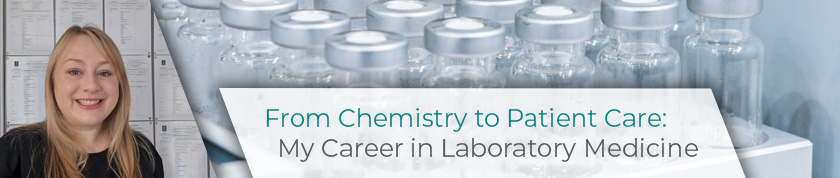

Gemma Brett
Healthcare Science Practitioner Advanced (Research)
Weqas Reference Measurement Laboratory
When people think about careers in healthcare, they often picture patient-facing roles. However, behind every reliable laboratory result is a team of healthcare scientists working to ensure measurements are accurate, traceable and safe.
As a Healthcare Science Practitioner Advanced (Research) in the Weqas Reference Measurement Laboratory, I use my background in analytical chemistry to help develop highly specialised measurement procedures. It is a varied and rewarding role that combines scientific research, complex problem-solving, collaboration and training.
Putting analytical science into practice
My role at Weqas involves a wide range of scientific projects.
I have completed the implementation of reference measurement procedures for cortisol, testosterone and sodium. My current project list includes calcium, potassium and progesterone.
These projects require a detailed understanding of the molecules being measured, the analytical techniques involved and the potential factors that could affect a result. Developing robust measurement procedures supports the accuracy and traceability of laboratory testing, helping laboratories produce results that healthcare professionals can trust when making decisions about patient care.
Another significant project involved converting our gas chromatography-mass spectrometry instruments, known as GC-MS systems, from helium to hydrogen carrier gas. This was a major undertaking that required careful planning, testing and validation to ensure the instruments and methods continued to perform as expected.
The project demonstrated one of the aspects I enjoy most about science: even an established laboratory technique can evolve, presenting new challenges and opportunities to improve how we work.
From a chemistry degree to healthcare science
My route into laboratory medicine began with a Master’s degree and PhD in Chemistry, specialising in physical and analytical chemistry.
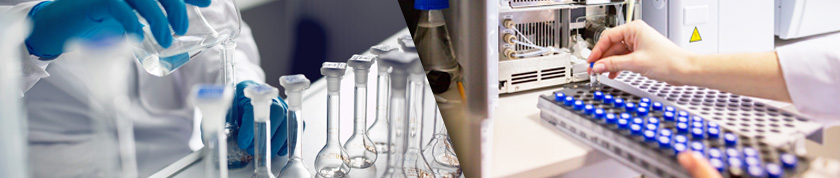
During my studies, I developed knowledge and practical experience in several techniques that I now use in the Reference Measurement Laboratory, including:
- Gas chromatography, or GC
- Liquid chromatography, or LC
- Inductively coupled plasma mass spectrometry, or ICP-MS
- Mass spectrometry
- UV spectrophotometry
- Other spectrophotometric measurement techniques
My academic background helps me understand not only how these analytical techniques work, but also the chemistry taking place at each stage of a procedure.
In the laboratory, we use complex sample-processing techniques selected according to the chemical properties of the molecules we need to measure. For example, we may use derivatising agents that react with the molecule of interest to form a new chemical species that is more suitable for measurement.
My degree trained me to understand these reactions and visualise what is happening at a molecular level. This helps me assess procedures, investigate unexpected results and make informed decisions during method development and validation.
It is a clear example of academic theory being translated into real-world practice. By understanding the science behind the measurement, we can help ensure procedures are accurate, reliable and appropriate for their intended use. This ultimately contributes to patient safety.
The value of mentorship
Mentorship played an important role in developing my confidence and scientific expertise. During my PhD, I was supported by a postdoctoral research assistant as well as the principal investigator leading the project. My postdoctoral mentor had already completed a PhD and had practical experience using many of the techniques involved in my research.
Their support went beyond technical knowledge. They helped me develop essential skills in time management, problem-solving and managing a complex research project over three years.
Scientific careers are built through learning from others as well as through formal study. Having experienced people who are willing to share their knowledge, offer guidance and encourage independent thinking can make a significant difference to a developing scientist.
Continuing to learn and contribute
Continuous professional development has remained an important part of my career. I have delivered presentations at scientific conferences, universities, and museums. Communicating with different audiences has taught me how to make complex scientific ideas more accessible while maintaining their accuracy.
I have co-authored 38 scientific research papers and am a member of the Joint Committee for Traceability in Laboratory Medicine review teams for non-peptide hormones and metabolites. These experiences allow me to contribute to the wider scientific community while continuing to develop my own knowledge. They have also strengthened skills that are important in laboratory medicine, including critical appraisal, scientific writing, collaboration and communicating evidence clearly.
Learning through training others
One of the most rewarding aspects of my role is welcoming visitors to the laboratory and supporting the development of other healthcare science professionals.
I have had opportunities to work with biomedical scientists, trainee clinical scientists, associate practitioners and medical laboratory assistants. Each person brings a different level of experience and a unique perspective, which makes training a valuable learning experience for everyone involved.
The Reference Measurement Laboratory uses specialist methods and techniques that many visitors may not have encountered in their usual working environment. This gives us an opportunity to share knowledge about areas such as:
- Metrological traceability
- Specialist sample-preparation techniques
- Reference measurement procedures
- Isotope dilution mass spectrometry
- New analytical instrumentation
Visitors often ask follow-up questions that encourage us to explain why a process is performed in a particular way, rather than simply describing the individual steps. These conversations can challenge your thinking, reinforce your understanding and help you see familiar procedures from a new perspective.
Helping others discover the magic of science
My enjoyment of training is closely connected to my enthusiasm for making science accessible.
In a previous role, I took part in outreach projects in schools. Inspiring children by showing them the magic of science remains one of my favourite career memories.
Today, I find it equally rewarding to train new members of staff in complex techniques such as isotope dilution mass spectrometry and the use of new instrumentation. These methods can initially seem daunting, so it is particularly satisfying to see someone develop their understanding, practical skills and confidence.
Training others also deepens your own knowledge. Explaining a scientific concept clearly requires you to examine your understanding and consider it from another person’s point of view. It creates an environment in which both the trainer and learner can grow.
Why choose a career in laboratory medicine?
Science is a fantastic career for anyone who enjoys solving problems, asking questions and working in a field that changes rapidly.
New methods, technologies and equipment mean that scientists continue learning throughout their careers. Laboratory medicine offers the additional reward of knowing that your work supports healthcare and contributes to the reliability of results used in patient care.
There is also no single route into the profession. My journey began in chemistry and research, but laboratory medicine brings together people with many different qualifications, experiences and areas of expertise.
For anyone considering a career in science, my advice would be to stay curious, take opportunities to develop practical experience and learn from the people around you. Be willing to ask questions and do not be discouraged when an experiment or method does not work immediately. Problem-solving is not a setback in science. It is a fundamental part of the job.
A career in laboratory medicine gives you the opportunity to combine scientific discovery with real-world purpose. For me, that combination continues to make it an exciting, challenging and genuinely rewarding field.
About the author
Gemma Brett is a Healthcare Science Practitioner Advanced (Research) in the Weqas Reference Measurement Laboratory. She has a Master’s degree and PhD in Chemistry, specialising in physical and analytical chemistry. Her work includes the development and implementation of reference measurement procedures, advanced analytical techniques and the training of healthcare science professionals. Gemma has co-authored 38 scientific research papers and contributes to the Joint Committee for Traceability in Laboratory Medicine review teams for non-peptide hormones and metabolites.
Last updated: 06/11/2026